Start With Demand, Not a Grand Network
The fastest way to lose money is to build a network for the map you imagine instead of the demand that exists. Start small, use the city and supply information panels, and let actual passenger and cargo demand choose your first routes.
Pause before placing your first station. Select a town and review its supplies, passenger destinations, and district layout. Residential areas create passenger demand, commercial districts need consumer goods, and industrial districts request industrial supplies. This tells you where stops will matter.
| Need to inspect | What it reveals | Early-game decision |
|---|---|---|
| Town supplies | Requested commercial and industrial goods | Choose one nearby cargo need |
| Passenger destinations | Where residents want to work or shop | Connect towns with visible demand |
| City district overlay | Residential, commercial, and industrial zones | Put stops within useful coverage |
| Industry inputs and outputs | Required materials and possible buyers | Build only the links needed for a chain |
For an early passenger line, a compact bus loop is usually enough. Cover the main residential, commercial, and industrial zones rather than trying to serve every street. Watch each stop's coverage radius while placing it; a well-positioned stop can serve many buildings without adding another vehicle or detour.
Intercity service should also follow the numbers. If one nearby town has notably more workers or shoppers traveling to your starting town, that corridor is a better candidate than a visually convenient route with little demand.
Start with a later era if you are new and want more forgiving vehicle performance. Earlier starts can be satisfying, but slow vehicles, smaller capacities, and weaker margins leave less room for route-planning mistakes.
Build Lines That Can Expand
Make early construction choices that leave space for the company you want later. A cheap layout is only cheap if you do not have to demolish it once traffic and demand increase.
Keep depots close enough that vehicles do not spend a long time traveling empty before starting service. Do not place them in dense housing, however. Depots, stations, freight facilities, and heavy traffic can create noise and pollution that reduce residential satisfaction. Commercial and industrial edges are generally safer locations.
When building beside a road that may need widening, set stations and buildings back from the roadside. Connect them with a short access road instead of blocking future road upgrades. This small gap can save a costly rebuild.
| Structure | Best placement principle | Common mistake |
|---|---|---|
| Bus or truck stop | Side street with strong building coverage | Blocking a one-lane arterial road |
| Depot | Near its routes, away from housing | Sending vehicles on long empty trips |
| Freight terminal | Near industry or city edge | Putting noisy logistics beside homes |
| Rail station | Where tracks can continue through | Using a terminal station on a future main line |
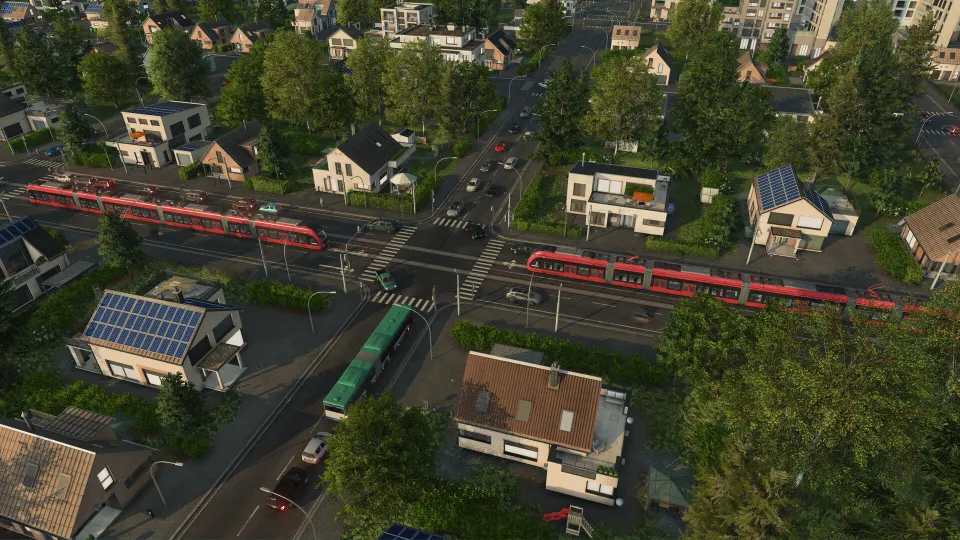
For rail, avoid treating every station as the end of the line. Put a main track past the station and connect the platforms as a branch where practical. Through trains can then keep moving while other services call at the station. This becomes much more valuable once several lines share a corridor.
Maintenance facilities deserve the same planning. Their coverage is especially useful near places where vehicles spend time stopped, such as stations. A facility beside a fast mainline may look central on the map but can be less effective than one covering several busy stops.
Make Traffic and Satisfaction Part of the Plan
Road traffic is not just a visual problem in Transport Fever 3. Congestion makes lines slower, worsens service quality, and can push people toward private cars. Design routes so buses and trucks do not become the cause of their own delays.
Use passenger-flow information to find corridors where many people drive privately. A direct, frequent public route along that desire line can convert demand more effectively than an elaborate network with multiple transfers. Check passenger satisfaction after opening a line, especially where riders complain about travel time.
Use these habits when planning road service:
- Put stops on side streets when they can still cover the intended buildings.
- Keep buses off crowded freight approaches where possible.
- Avoid unnecessary loops; every extra turn lowers useful frequency.
- Build a direct local line first, then add intercity service when demand supports it.
- Recheck service coverage after a town grows beyond your original stops.
| Overlay or metric | What to look for | What to change |
|---|---|---|
| Passenger flow | High private-car movement between two places | Add or improve a direct public link |
| Passenger satisfaction | Dissatisfaction with speed or access | Shorten routes or improve frequency |
| Infrastructure coverage | New neighborhoods outside stop coverage | Extend a line or add a targeted stop |
| City districts | Housing near noisy traffic or terminals | Reroute freight and relocate future facilities |
Cities grow when passenger movement and supplies are handled well, but do not confuse growth with a reason to overbuild. Extend coverage when the city has actually spread beyond your network. A single targeted stop often solves a coverage problem more efficiently than duplicating an entire line.
Grow Profitably With Cargo and Capacity
Once a basic passenger service is stable, add a short cargo route. Choose a requested product with a nearby source or a simple chain you can understand. Fish, crops, logs, and other straightforward goods can be easier starting points than a long multi-stage industrial operation.
Check industries directly before committing. Some sites produce goods independently and accept optional inputs that improve output, while others need an input shipment before they can make anything. A refinery, for example, needs oil delivered before it can produce its outputs. Do not buy vehicles for the final product before confirming that the chain can run.
| Cargo situation | Recommended approach | Why it works |
|---|---|---|
| Town needs a nearby raw good | Use a short truck or boat route | Low construction and operating cost |
| Industry has an output buyer nearby | Move output directly to that buyer | Fewer transfers and less delay |
| Cargo changes transport mode | Add a warehouse at the transfer | Keeps exchange points organized |
| Industry needs an input first | Supply the input before expanding output | Activates the production chain |
| Long-distance demand | Consider rail, water, or air later | Higher infrastructure cost needs volume |
Aim to keep vehicles usefully loaded in at least one direction. A half-empty high-capacity train can look impressive while losing money through maintenance and operating costs. Start with a smaller vehicle or fewer vehicles, then increase capacity only when the line’s current service is consistently crowded or cannot meet demand.
Review line performance before adding vehicles. Capacity tells you what the line can carry; utilization shows whether that capacity is being used; frequency indicates how often service arrives; rate and balance reveal whether the route is actually delivering enough volume and earning its costs.
Do not upgrade simply because a newer vehicle becomes available. A faster train, larger ship, or bigger truck should solve a proven bottleneck. If demand does not justify it, the upgrade can turn a profitable route into an expensive underused one.
FAQ: Transport Fever 3 Tips
What are the best Transport Fever 3 tips for a first route?
Inspect the town’s supply and passenger panels first, then build a small bus route that connects residential, commercial, and industrial districts. Keep the depot nearby but outside dense housing, and wait for performance data before buying more vehicles.
Should I focus on passengers or freight first?
Either can work, but a short, clear cargo route often provides dependable income while a local passenger loop builds city connectivity. Choose the opportunity with visible demand and the lowest construction cost rather than forcing a large rail project early.
Why are my buses or trucks slow?
They may be stuck in traffic, making too many stops, or using a route with unnecessary turns. Move stops off busy arterial roads when coverage allows, simplify the line, and use passenger-flow data to focus service on the routes people actually want.
How do I know when to add another vehicle?
Check utilization, frequency, capacity, rate, and balance after the existing line has operated for a while. Add a vehicle when demand is consistently exceeding service, not immediately after opening the line.
Where should I place train stations?
Leave room for through tracks and future expansion. A station connected directly to a terminating track can become a bottleneck later, while a station alongside a continuing mainline gives future trains more options.